

Regulatory strategy as a design input, not an output
A regulatory decision made early in medical device development can influence far more than the eventual submission. It can affect device architecture, software classification, risk controls, verification methods, usability activities, and the clinical evidence a development team ultimately needs to generate.
When regulatory requirements are considered only after key design decisions have been made, teams may discover that the evidence they have generated does not fully support the intended regulatory pathway. Treating regulatory strategy as a design input changes that approach.
In modern medical device development, regulatory strategy should not be treated as a downstream documentation exercise. Instead, it should be considered a foundational design input that can shape device architecture, safety strategy, verification planning, and clinical evidence generation.
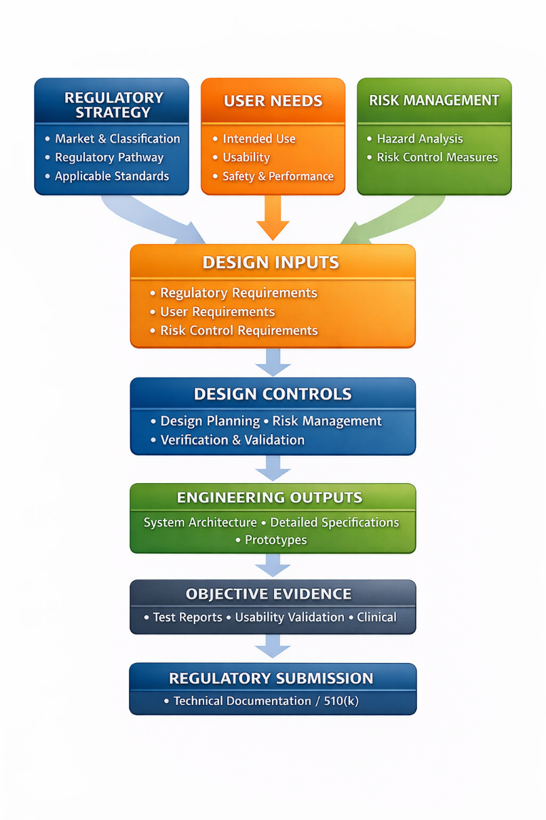
The diagram above illustrates a systems engineering aligned design control architecture where regulatory strategy, user needs, and risk management serve as primary requirement sources feeding into structured design inputs. These inputs consolidate regulatory constraints, intended use specifications, and risk control requirements in accordance with ISO 13485:2016 design input expectations. The design inputs are operationalized through design control mechanisms including planning, integrated risk management, and verification and validation activities. Resulting engineering outputs such as system architecture and detailed specifications generate objective evidence through testing, usability validation, and clinical evaluation aligned with ISO 14971:2019 risk management principles. This traceable evidence chain ultimately supports regulatory submissions required under frameworks like the FDA Quality Management System Regulation (QMSR), 21 CFR Part 820, and EU Medical Device Regulation (MDR) 2017/745.
From a systems engineering standpoint, regulatory strategy acts as a meta-requirement layer governing the device development framework. When treated as an input, it can help align the device’s technical architecture, risk profile, and evidence generation strategy with applicable regulatory expectations throughout development.
Embedding Regulatory Strategy Early: Practical Steps
Translating regulatory strategy into a design input requires structured integration into the development lifecycle. The following practices enable early and effective alignment:
Regulatory Design Reviews at Key Milestones
Conduct formal regulatory checkpoints at concept freeze, design input review, and design freeze to validate review classification, applicable regulations, and standards alignment.
Harmonized Standards Mapping During Design Inputs
Develop a standards checklist an applicable standards checklist early, mapping requirements from ISO 14971, IEC 62304, IEC 62366-1, etc., directly relevant requirements from standards such as ISO 14971, IEC 62304, and IEC 62366-1 into design inputs, verification plans, and acceptance criteria.
Early Risk and Clinical Strategy Alignment
Define risk acceptability criteria, clinical endpoints, and labelling intent upfront to ensure support consistency across risk management, verification, and clinical evaluation activities.
Pre-Submission Engagement with Regulators
Where appropriate, use mechanisms such as FDA Q-Sub meetings Q-Submission interactions or engagement with a Notified Body to seek feedback on regulatory pathways, testing strategies, and clinical approaches before key design decisions are finalized.
Integrated Traceability Framework
Establish traceability from regulatory requirements → design inputs → risk controls → verification → clinical evidence, supporting the generation of traceable evidence for regulatory purposes.
Cross-Functional Governance Model
Ensure regulatory, engineering, clinical, and quality teams collaboratively define and review design inputs, avoiding sequential or siloed decision making.
Regulatory Strategy Defines the Development Pathway
Under frameworks such as EU Medical Device Regulation (MDR) 2017/745, U.S. FDA 21 CFR Part 820 the FDA Quality Management System Regulation (QMSR), 21 CFR Part 820, and ISO 13485:2016, regulatory expectations influence the entire design lifecycle. Regulatory strategy should guide how a device is designed, not simply how the design is documented for submission.
A well-defined regulatory strategy helps determine:
- Device classification and rule applicability
- Required preclinical testing and standards
- Clinical evaluation or clinical investigation needs
- Submission pathway (510(k), De Novo, PMA, Technical Documentation)
- Post-market obligations and surveillance planning
When this strategy is defined early, the design team can better align technical evidence generation with regulatory acceptance criteria from the outset.
Regulatory Requirements Translate into Design Inputs
Design inputs should systematically incorporate regulatory constraints derived from standards such as ISO 14971:2019 for risk management and IEC 62366-1 for usability engineering.
Examples of regulatory-driven design inputs include:
|
Regulatory Consideration |
Translation into Design Input |
|
Classification rule |
Safety architecture and risk control depth |
|
Harmonized standards |
Applicable verification methods |
|
Essential safety and performance requirements |
Functional specifications |
|
Usability expectations |
Human factors engineering inputs |
|
Clinical evaluation requirements |
Performance endpoints and labelling claims |
Thus, regulatory strategy becomes a system-level constraint framework guiding design decisions rather than merely documenting them.
Impact on Risk Management and Verification
When regulatory strategy is treated as a design input, it creates structured traceability across development artifacts:
Regulatory Requirements → Design Inputs → Risk Controls → Verification Evidence → Clinical Evaluation
This alignment can help establish a development approach in which:
-
Risk controls are aligned with regulatory expectations.
-
Verification activities are planned to generate evidence against defined requirements and acceptance criteria.
-
Residual risks can be evaluated and documented within clinical benefit-risk frameworks.
When these activities are not sufficiently connected, gaps may emerge later in development, potentially resulting in additional testing, evidence generation, or design changes.
Where Late Regulatory Integration Can Create Gaps
When regulatory considerations are introduced after important design decisions have been made, gaps can emerge between the product architecture, applicable requirements, verification activities, and the evidence ultimately needed for regulatory purposes.
Misaligned Test Methods with Harmonized Standards
If applicable standards are identified too late, verification methods or acceptance criteria may require reassessment. Early consideration of standards such as ISO 14971, IEC 60601, and IEC 62304 can help teams define appropriate methods and acceptance criteria before verification begins.
Inadequate Usability Validation Scope
When human factors are considered late, important users, use environments, use-related risks, or critical tasks may not have been sufficiently addressed during development. Early planning per IEC 62366-1 can help define users, environments, and critical tasks before validation scope is finalized.
Clinical Evidence Gaps
Intended use, claims, endpoints, and the regulatory pathway are closely connected. Considering them together early can help teams plan clinical evidence that is appropriate for the intended regulatory strategy.
Unsupported Labelling Claims
Considering claims early can help identify the verification or clinical evidence that may be needed to support them.
Incomplete Risk Integration with Design Controls
Risk management should interact with design and development rather than operate as an isolated activity. Early linkage of hazards to design inputs can help incorporate risk controls into the architecture.
Late Identification of Software and Cybersecurity Risks
For software-enabled and connected devices, identifying software and cybersecurity requirements only after the architecture is established can create additional development challenges. Early classification and threat modelling can help teams incorporate appropriate controls and validation activities into the development approach.
Together, these examples illustrate why regulatory considerations are most useful when they inform development planning rather than being retrofitted after key engineering decisions have been made.
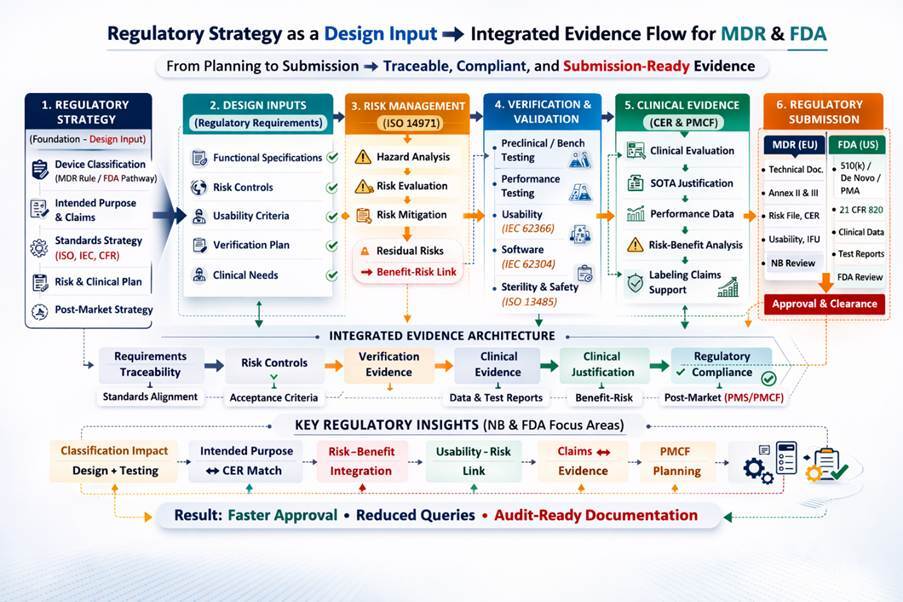
Regulatory Strategy as a Design Input: Structuring the Evidence Architecture for MDR and FDA Compliance
The role of regulatory strategy continues across each stage of the medical device lifecycle, connecting early pathway decisions with design inputs, evidence generation, submission activities, and post-market feedback.
Concept & Feasibility Phase
Regulatory strategy defines device classification, intended use, and applicable frameworks.
Output: Regulatory pathway, high-level risk classification, standards identification.
Design Input Phase
Regulatory requirements are translated into measurable inputs including safety requirements, usability constraints, clinical endpoints, and applicable standards.
Output: Structured, regulatory-aligned design inputs.
Design & Development Phase
Regulatory expectations guide architecture decisions, risk control implementation, and software classification.
Output: Design outputs developed with applicable regulatory requirements in consideration.
Verification & Validation Phase
Test methods, usability validation, and clinical evaluation are executed in alignment with regulatory acceptance criteria.
Output: Submission-ready objective evidence.
Pre-Market & Submission Phase
Evidence is compiled into a coherent regulatory narrative.
Output: Traceable, regulator-ready submission.
Post-Market Phase
PMS, vigilance, and real-world data feed back into risk management and design updates.
Output: Ongoing input into compliance activities and lifecycle risk management.
Conclusion:
Embedding regulatory strategy as a design input connects regulatory expectations with the engineering decisions that shape a medical device. It brings design architecture, risk management, verification, and clinical evidence into a more coherent and traceable development framework.
By integrating regulatory thinking early, organizations can identify potential evidence gaps sooner, reduce avoidable rework, and build a clearer path from design decisions to regulatory submission.
Regulatory strategy therefore becomes not just a submission consideration, but an integral part of how a medical device is designed and developed.
As medical devices become increasingly software-driven, connected, and complex, maintaining alignment between regulatory strategy and engineering decisions throughout the product lifecycle becomes increasingly important. Regulatory strategy is therefore not simply a consideration for submission, but part of the framework through which a medical device is designed, developed, verified, and supported throughout its lifecycle.
Bringing Regulatory and Engineering Expertise Together
Decos HealthTech works with medical device manufacturers to bring regulatory considerations into the engineering process—from new product development and risk management to cybersecurity and usability engineering. By connecting these disciplines earlier, our teams help establish traceability between requirements, risks, controls, verification evidence, and clinical requirements throughout the product development lifecycle.
Planning a new medical device or reviewing an existing development approach? Talk to our engineering specialists about integrating regulatory requirements earlier in the product development lifecycle.